Tag: 2026 Midterms

  • US Electoral College: 3 Shocking Voting System Secrets

    A unique architectural infographic illustrating the mechanics and flaws of the US Electoral College system.
    The US Electoral College remains one of the most unique and debated constitutional mechanisms in global politics.

    Imagine winning the national popular vote by over 500,000 ballots and still losing the presidency of the United States. This is not a dystopian political fiction; it was the exact reality of the 2000 presidential election. In most modern constitutional democracies, the mathematical formula for securing executive power is absolute: the candidate with the most individual votes wins the office. However, the American republic operates on a completely unique architectural anomaly known as the US Electoral College, a systemic blueprint where geographical boundaries matter far more than numerical majorities.

    The Mechanism: Popular Vote vs. Electors

    To understand why the American system functions through this fragmented framework, one must analyze the stark structural divergence between the will of the individual populace and the allocation of institutional electoral points.

    Electoral Element National Popular Vote US Electoral College System
    Core Target Total individual citizen ballots cast across the nation. 538 total electoral points allocated to states.
    Winner Criterion Absolute mathematical majority of the entire population. Securing a minimum threshold of 270 electoral points.
    State Mandate Treats all citizens as a single, unified electorate. Utilizes a high-stakes “Winner-Take-All” state-level model.

    1. The Winner-Take-All Rule: Erasing Minority Ballots

    The primary mechanical flaw that shocks external observers is the state-level “winner-take-all” framework utilized by 48 out of 50 states. Under this system, if a candidate wins a state by a razor-thin margin of just a single individual ballot, they are immediately awarded 100% of that state’s electoral points.

    This mechanical allocation effectively erases millions of opposition ballots cast within that state. For instance, a conservative voter residing in a deeply progressive state, or a progressive voter living in a heavily conservative state, discovers that their individual ballot possesses zero structural leverage on the national stage. This concentration of power heavily mirrors the structural block voting parameters analyzed in our foundational guide on the [US Midterm Elections 2026].

    2. The Swing State Monopoly: Engineering the Campaign Trail

    Because the vast majority of states possess deeply entrenched, predictable partisan alignments, the entire national presidential campaign effectively contracts into a handful of highly volatile “swing states.” Factions completely ignore safe states, focusing their massive corporate funding, television advertisements, and policy promises exclusively on a tiny percentage of the national electorate.

    This geographical insulation alters the legislative priorities of the federal government. Budgets, infrastructure spending, and specialized industrial subsidies are routinely directed toward these swing regions to buy political favor. As heavily detailed in our extensive investigation regarding the concentration of budgetary authority and [Rosa DeLauro Power], federal resources are continuously weaponized to secure electoral leverage ahead of critical constitutional deadlines.

    [Expert Analytical Insight: The Institutional Protection of Minority Tyranny]

    The traditional defense of the US Electoral College dictates that it prevents a few highly populated metropolitan cities from dominating national policy. However, the modern reality exposes a far more dangerous systemic hazard: it actively subsidizes minority tyranny. When a candidate can capture the highest office in the world while experiencing a massive deficit in the national popular vote, the foundational concept of democratic legitimacy is shattered.

    This structural disconnect deepens public cynicism, convincing the citizenry that the entire voting infrastructure is an engineered illusion designed to protect establishment entities. Rather than fostering national unity, this archaic cartography locks the nation into a state of permanent polarization, where rural and urban geographies treat each other as existential threats rather than co-equal participants in a shared constitutional republic.

    The Digital Vulnerability and Legislative Overhaul

    The friction surrounding this complex system has intensified due to the integration of modern hyper-targeted digital media campaigns. Foreign and domestic political action committees no longer need to alter public opinion across the entire United States; they merely need to manipulate a few thousand swing-state voters using advanced algorithmic modeling.

    Managing this micro-targeted digital warfare has forced state capitals to implement aggressive new safeguards, a crisis thoroughly explored in our current report on [AI Election Laws]. If the legislature fails to establish uniform transparency parameters, the stability of the entire voting system faces severe vulnerability.

    Furthermore, procedural changes to electoral count rules are constantly blocked by entrenched institutional dynamics, a state of gridlock fueled by tools like the Senate supermajority rule, as outlined in our comprehensive breakdown of [What is Filibuster] . According to historical archival data hosted via the National Archives and Records Administration  [Electoral College Functions], any structural reform to this constitutional process requires an amendment threshold that modern polarized majorities simply cannot achieve.

    Conclusion: The Cartography of Tomorrow

    Ultimately, the survival of the American electoral architecture depends heavily on whether the public continues to accept a system where a dollar or a geographic boundary holds more leverage than an individual voice. While the constitutional framework remains highly insulated from radical structural change, the growing divide between the popular vote and the electoral winner poses a continuous, lingering challenge to the stability of the republic.
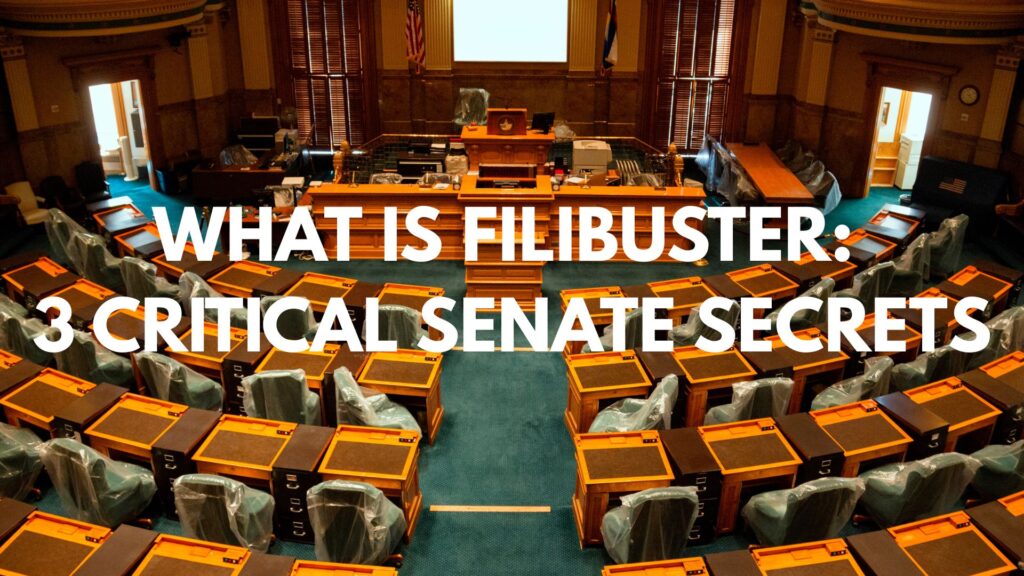

  • What is Filibuster: 3 Critical Senate Shock Secrets

    A professional infographic conceptualizing what is filibuster and illustrating the 60-vote cloture threshold in the US Senate.
    The filibuster remains a powerful and highly debated legislative tool used to delay or block voting in the United States Senate.

    The legislative architecture of the United States Senate is intentionally designed to protect the influence of the minority faction. Unlike lower parliamentary bodies where a simple majority can instantly pass sweeping statutory adjustments, the upper chamber of the American legislature operates on a framework of forced consensus. To decipher why major institutional bills frequently stall in Washington, one must fundamentally ask: What is filibuster, and why do both major political parties systematically preserve this highly controversial mechanism of systemic obstruction?

    1. The Mechanics of Obstruction: The 60-Vote Threshold

    The historical evolution of the Senate has transformed the concept of extended debate into a formidable procedural weapon. Originally, a filibuster required a senator to physically occupy the Senate floor and speak uninterrupted for hours to delay a vote. Today, the modern iteration functions through a streamlined, silent framework where a minority party simply signals their intent to obstruct, triggering an automatic requirement for a supermajority to proceed.

    To terminate a filibuster and force a final vote on a bill, the Senate must invoke a procedure known as “cloture.” According to the official historical guidelines managed by the United States Senate procedural archives  [US Senate Cloture Rules], invoking cloture requires a strict 60-vote threshold. In a deeply polarized legislature where neither party routinely holds a 60-seat supermajority, the mere threat of a filibuster effectively guarantees that any controversial bill requires bipartisan compromise to survive.

    2. The Strategic Paradox: Why Neither Party Will Kill the Rule

    When a political party secures a trifecta—controlling the White House, the House of Representatives, and a simple majority in the Senate—the filibuster is routinely condemned as an archaic barrier to democratic progress. Progressive and conservative factions alike frequently demand the complete elimination of the rule to pass their signature legislative agendas.

    However, when given the actual opportunity to permanently dismantle the mechanism, leadership from both sides historically hesitates. The strategic paradox lies in the cyclical nature of institutional power. Modern political strategists are acutely aware that majorities are inherently temporary. By preserving the 60-vote threshold, the party currently in power protects its future self; they ensure that when they eventually lose the majority, they will still possess a structural veto to block the incoming opposition’s most radical policy adjustments.

    [Expert Analytical Insight: The Shield of Bureaucratic Cowardice]

    The public debate surrounding what is filibuster focus entirely on partisan gridlock, yet its true institutional utility is far more cynical: it functions as a shield for bureaucratic cowardice. The 60-vote rule allows senators to performatively champion radical, base-pleasing legislation on cable news, fully aware that the bill will safely die in the Senate without them ever having to vote on its complex real-world consequences.

    The systemic hazard is that the filibuster creates an environment of engineered stagnation. It strips the majority party of its structural accountability, allowing politicians to blame a procedural rule for their own governing paralysis. When the legislature systematically defaults to inaction, the public begins to view the entire democratic apparatus as functionally broken, transferring the true velocity of policy-making away from elected representatives to unelected judicial courts and unilateral executive orders.

    Linking Senate Stagnation to the 2026 Legislative Shifts

    The preservation or alteration of this procedural rule remains the highest structural stake in the upcoming federal challenges. If a faction secures a narrow majority, the internal pressure to deploy the “nuclear option”—permanently lowering the cloture threshold to a simple 51-vote majority for specific issues—will intensify.

    Altering this single procedural lever would instantly unlock the floodgates for sweeping federal changes on environmental regulations, corporate tax overhauls, and judicial packing. As established in our primary foundational framework regarding the  [US Midterm Elections 2026], the exact partisan balance of the upper chamber dictates whether the filibuster survives as a constitutional brake or dissolves into historical irrelevance.

    Conclusion: The Constitutional Anchor

    Ultimately, the mechanism of institutional obstruction remains the defining characteristic that separates the Senate from any other legislative body in the world. While it undeniably breeds public frustration and delays urgent statutory relief, it serves its original constitutional purpose: anchoring the republic against volatile swings in popular passion. Understanding the strategic mechanics behind this rule is the only method for accurately predicting the real trajectory of American law.

  • AI Election Laws: 3 Critical Voting Shock Secrets

    A modern high-tech infographic showing how new AI Election Laws regulate deepfakes and synthetic media in political advertising.
    New state and federal regulations are enforcing strict disclosure rules on AI-generated content ahead of major elections.

    The intersection of generative technology and democratic processes has created an unprecedented regulatory crisis in modern governance. As political campaigns capitalize on advanced algorithmic tools to maximize voter outreach, the rapid proliferation of synthetic media has forced a historic legislative overhaul. The implementation of comprehensive AI Election Laws has suddenly shifted from a theoretical tech-sector debate into an urgent constitutional shield designed to protect the baseline integrity of the democratic ballot from untraceable digital manipulation.

    1. The Legal Framework: Banning Synthetic Deception in Campaigns

    The primary catalyst behind the sudden acceleration of federal and state-level legislation is the weaponization of audio and video deepfakes. Unlike traditional attack ads, which rely on hyper-partisan framing or selective editing, generative AI allows malicious actors to fabricate completely realistic, entirely non-existent scenarios where candidates appear to confess to crimes or make highly controversial statements just hours before voting begins.

    To combat this systemic vulnerability, lawmakers have introduced strict statutory penalties for campaigns utilizing undisclosed synthetic media. According to official regulatory policy drafts published by the Federal Election Commission [FEC Artificial Intelligence Rulemaking], new guidelines mandate prominent, unmissable digital watermarks and explicit disclaimers on any political advertisement generated via artificial intelligence. For political strategists, failing to comply with these transparency directives results in immediate criminal liability and massive financial penalties, altering how digital campaigns operate across the United States.

    2. State-Level Autonomy vs. Federal Stagnation

    Because comprehensive federal tech regulation frequently faces gridlock in Washington, individual state legislatures have taken the initiative to construct their own defensive legal perimeters. Over half of US states have successfully passed bipartisan statutes criminalizing the unauthorized distribution of politically deceptive deepfakes within a strict window—typically 90 to 120 days—preceding an election.

    This rapid, fragmented state-level expansion creates a highly complex compliance landscape for national political action committees. An advertisement that is perfectly legal under federal guidelines might trigger immediate litigation or social media platform deplatforming when geo-targeted to voters in a state with highly restrictive synthetic media laws. This legal friction places immense pressure on legal compliance teams to rigorously verify the digital lineage of every piece of promotional content distributed to the electorate.

    [Expert Analytical Insight: The Epistemic Hazard of Digital Skepticism]

    The true operational danger of the generative revolution lies not in the public believing a fake video, but in the public refusing to believe any real video. This systemic psychological shift is historically recognized as the “liar’s dividend.” When synthetic media becomes indistinguishable from reality, corrupt political actors gain a permanent, universal escape hatch. They can simply dismiss authentic, damning evidence of corruption or incompetence as an “AI-generated deepfake.”

    The underlying systemic hazard within new legal frameworks is that they struggle to solve this psychological decay. Laws can regulate official campaign expenditures, but they cannot stop anonymous, foreign-backed entities from flooding decentralized communication channels with untraceable synthetic disinformation. By focusing entirely on commercial disclaimers, the state constructs an artificial illusion of security while the foundational trust required to sustain a shared reality continuously dissolves from underneath the citizenry.

    The Technological Battle for the Congressional Gavel

    The strategic deployment of these digital legal barriers heavily influences the broader trajectory of national political power. The political faction that successfully navigates this highly restrictive media environment will capture an immense advantage in securing regional majorities.

    Controlling the legislative framework allows a party to dictate the future boundaries of technology sector antitrust laws, social media immunity protections, and data privacy rights. As established in our primary foundational matrix regarding the [US Midterm Elections 2026], the composition of the chambers will determine whether the United States adopts a highly regulated, European-style technology containment policy or maintains a permissive, free-market approach to digital innovation.

    Conclusion: Reclaiming the Truth

    Ultimately, the battle over synthetic media regulations is a fundamental defense of the concept of objective reality within a constitutional republic. While technology will inevitably continue to outpace the velocity of legislative drafting, the implementation of structured transparency rules is an essential baseline. For the contemporary electorate, maintaining a vigilant, highly analytical approach to media consumption is no longer just a civic virtue; it is the ultimate defense mechanism required to preserve the authenticity of the ballot.

  • Rosa DeLauro Power: 3 Critical Shocking Secrets

    A professional infographic breakdown illustrating the legislative influence and role of Rosa DeLauro in the federal appropriations process.
    The leadership of the House Appropriations Committee controls the foundational flow of federal spending in American politics.

    The true mechanics of American federal governance are seldom executed in the high-profile arena of the televised floor debates. Instead, systemic authority resides within the intricate legislative framework where public capital is meticulously allocated to federal agencies. At the epicenter of this structural distribution sits the immense architectural legacy of Rosa DeLauro Power, a senior legislative force whose management of the House Appropriations Committee dictates the structural domestic priorities of the United States, transferring abstract policy promises into concrete fiscal realities.

    1. The Gatekeeper of the Purse Strings: The Appropriations Monarchy

    The foundational bedrock of this institutional influence is rooted in the constitutional mandate that all federal spending must originate from legislative consensus. The House Appropriations Committee serves as the primary gatekeeper for the nation’s discretionary spending budget—a fund total encompassing over a trillion dollars annually.

    As the ranking member and longtime leader of this powerful panel, the structural authority wielded through this position allows for direct, localized control over which federal programs receive robust capitalization and which face severe austerity. According to legislative operational data tracked by the official United States House of Representatives archives [House Appropriations Committee Records], this oversight role grants the chair unprecedented leverage during high-stakes government shutdown negotiations. For political analysts, understanding federal priority shifts is impossible without directly analyzing the strategic decisions made within this specific committee room.

    2. Earmarks and Localized Leverage: Sustaining Incumbency

    Beyond sweeping national budgets, the execution of this legislative authority is heavily driven by the strategic redistribution of community project funding, historically referenced as “earmarks.” This political mechanism allows senior lawmakers to directly allocate federal tax dollars to specific infrastructure, educational, or healthcare developments within their home districts.

    By mastering this complex transactional system, veteran leadership can insulate vulnerable members of their party from competitive electoral challenges. Directing tens of millions of federal dollars to a swing district creates a tangible track record of local economic delivery that challengers find nearly impossible to replicate. This micro-targeted allocation of resources transforms pure budgetary oversight into a formidable asset for maintaining party cohesion and sustaining corporate and local alliances across the United States.

    [Expert Analytical Insight: The Shadow Speakership]

    Modern media coverage routinely obsess over the identity of the Speaker of the House, yet this focus misses the true locus of administrative control. The Speakership is a volatile, highly vulnerable political position; the leadership of the Appropriations Committee represents permanent, structural leverage.

    The underlying hazard within this concentration of budgetary authority is that it functions as a shadow legislative monopoly. A single long-serving institutional gatekeeper can quietly stall or defund presidential executive orders simply by denying the necessary financial infrastructure. This structural friction ensures that regardless of which ideological faction captures national headlines, the deeply entrenched institutional elite retain the final veto power over the velocity of federal resource deployment, turning the public purse into a highly insulated instrument of establishment preservation.

    The 2026 Fiscal Deadlines and the Midterm Stakes

    The operational magnitude of this fiscal gatekeeping becomes incredibly vital leading into the high-stakes legislative deadlines of the current cycle. If control of the lower chamber alters following intense local challenges, the leadership of this powerful committee shifts immediately.

    A change in committee control alters everything from international security aid packages to domestic social welfare allocations. As heavily emphasized in our core structural analysis of the broader [US Midterm Elections 2026], the identities of the individuals controlling these powerful fiscal committees remain far more consequential for long-term domestic policy than the public rhetoric broadcast on cable news networks.

    Conclusion: The Currency of Governance

    Ultimately, political power in a constitutional republic is measured not by public popularity, but by the direct control over the allocation of national capital. The legacy of this institutional gatekeeping serves as a stark reminder that policy without funding is merely a delusion. For global markets and domestic observers alike, tracking the movements within the Appropriations leadership remains the single most accurate method for deciphering the real, unvarnished intentions of American leadership.

  • US Inflation Policy: 3 Critical Shocking Secrets

    A clear conceptual infographic breaking down the key differences in US Inflation Policy between major political factions.
    The ideological divide over fiscal spending and deregulation continues to shape the future of inflation control.

    The political friction defining contemporary economic discourse invariably centers on the purchasing power of the average consumer. As global markets navigate complex supply chain realignments and fluctuating monetary frameworks, the execution of US Inflation Policy has transformed into the primary ideological battleground ahead of the pivotal legislative cycles. While citizens demand immediate relief from escalating living costs, the two major factions offer fundamentally antithetical architectures for stabilizing the domestic currency, turning fiscal management into a high-stakes partisan proxy war.

    1. The Demand-Side Framework: Corporate Accountability and Supply Investment

    The Democratic approach to stabilizing prices operates through a progressive economic lens, identifying corporate behavior and supply chain vulnerabilities as the primary drivers of modern fiscal strain. Rather than utilizing broad austerity measures that could slow employment growth, this strategy focuses on targeted regulatory interventions designed to lower systemic costs for working-class households.

    A core pillar of this platform involves aggressive enforcement against corporate price-gouging and hidden junk fees that artificially inflate consumer expenses. According to official economic analytical reports published by the White House Council of Economic Advisers [CEA Economic Reports], sustainable price stability is achieved by investing directly in domestic manufacturing infrastructure, securing clean energy supply chains, and expanding healthcare subsidies. For this faction, reducing long-term structural expenses for families is far more vital than cutting public resources to combat monetary expansion.

    2. The Supply-Side Mandate: Deregulation and Fiscal Austerity

    In stark contrast, the Republican platform attributes the core cause of monetary devaluation directly to historic levels of federal spending and excessive regulatory burdens. The conservative model dictates that the most efficient method to control rising costs is to unleash domestic productivity by removing bureaucratic barriers, particularly within the traditional energy sector.

    By streamlining oil and gas permits, lowering the overarching regulatory compliance costs for corporations, and permanently extending comprehensive tax exemptions, this framework aims to trigger a supply-side expansion that organically drives down prices. Furthermore, the strategy heavily mandates a massive contraction of non-defense federal spending, arguing that injecting trillions of fiat dollars into the economy serves as the primary catalyst for inflation. For this faction, true fiscal stability returns when the federal apparatus steps back, allowing free-market competition to rebalance prices.

    [Expert Analytical Insight: The Shared Mirage of Price Stability]

    The underlying deception within the debate surrounding contemporary fiscal management is that both factions weaponize monetary metrics to validate preexisting ideological agendas. Neither side is entirely transparent about the real-world trade-offs. The progressive model risks sustaining structural deficits through continuous domestic subsidies, which can inadvertently feed long-term price pressures; the conservative model risks increasing short-term income disparity through aggressive deregulation and public asset contraction.

    The systemic reality is that price stability remains heavily dependent on the independent monetary tightening executed by the Federal Reserve, an entity insulated from standard legislative oversight. By promising the electorate that a simple change in congressional majorities can instantly fix global structural inflation, both parties construct a dangerous political illusion that sets up the public for continuous economic disappointment.

    Linking Economic Vulnerability to Legislative Supremacy

    The execution of these competing structural theories requires absolute control over the federal checkbook. Passing sweeping energy permits or altering the baseline tax structures cannot occur without a unified legislative mandate.

    The party that successfully dictates the fiscal agenda will shape the domestic standard of living for decades. As established in our primary foundational framework regarding the [US Midterm Elections 2026], the control of the legislative chambers remains the ultimate prerequisite for passing any structural economic adjustments, transforming every local race into a direct referendum on the nation’s financial future.

    Conclusion: The Architecture of Value

    Ultimately, the conflict over the ideal economic trajectory is a fundamental disagreement on the source of economic value. One side trusts public investment and corporate oversight to insulate the citizen, while the other bets on deregulation and industrial liberty to drive down costs. As long-term economic deadlines loom, the public must recognize that every vote cast is not merely a political choice, but a direct selection of the economic rules that govern their daily survival.

  • Why Is Republican Called GOP: 3 Critical Shock Secrets

    A clean historical infographic explaining the origins and meaning of the acronym GOP for the Republican Party.
    The acronym GOP, standing for Grand Old Party, has a deep-rooted historical origin dating back to the Civil War era.

    In the contemporary geopolitical landscape, minor acronyms frequently carry immense historical weight. While global media outlets continuously dissect the ideological movements of American conservatism, foreign observers and young domestic voters routinely encounter a puzzling semantic question: Why is Republican called GOP, and how did three simple letters transform into the ultimate institutional brand for one of the world’s most powerful political organizations? To fully comprehend the deep-rooted identity of American legislative battles, one must unearth the fascinating historical genealogy behind the “Grand Old Party.”

    1. The Civil War Legacy and the Birth of the “Grand” Moniker

    The roots of the phrase can be traced directly back to the tumultuous era of the American Civil War and its immediate aftermath. Founded in the 1850s as a dedicated anti-slavery coalition, the Republican Party rapidly achieved institutional dominance under the leadership of Abraham Lincoln. Following the preservation of the Union, the party aligned its identity with national survival, corporate industrial expansion, and constitutional preservation.

    Initially, the acronym did not possess its modern definition. In the late 19th century, military veterans and southern editorial writers began referencing the party as the “Gallant Old Party” to honor the Union soldiers who fought on the battlefields. According to historical records preserved within the Republican National Committee archives [GOP Historical Archives], this phrase gradually transitioned into “Grand Old Party” through a series of high-profile political speeches and major journalistic columns in the 1880s, permanently cementing the name in the American lexicon.

    2. The Technological Shift: How Typography Standardized the Acronym

    While the full phrase carried immense rhetorical prestige, the shorthand acronym “GOP” owed its standardized adoption to a purely pragmatic commercial variable: the evolution of print journalism and typesetting constraints. In the late 19th and early 20th centuries, newspaper editors faced severe layout limitations when building headline fonts on traditional printing presses.

    Spelling out “Grand Old Party” or even “The Republican Party” consumed precious vertical real estate on front pages. Typesetters discovered that the three-letter shorthand “GOP” allowed for massive, high-impact headline font configurations that immediately caught the reader’s eye at newsstands. What began as a mechanical workaround to save space quickly morphed into a permanent, highly efficient marketing brand that transcended the print medium, remaining universally recognized in the digital broadcasting era.

    [Expert Analytical Insight: The Paradox of Institutional Branding]

    The systemic irony embedded in the reality of why is Republican called GOP lies in the historical inversion of the brand itself. When the acronym was consolidated in the late 19th century, the Republicans were actually the progressive, radical, and disruptive force in American politics, responsible for uprooting old agrarian economic structures. Today, the moniker functions as a protective shield for traditionalism, fiscal conservatism, and constitutional originalism.

    This evolution demonstrates how elite political organizations utilize historical brand prestige to mask contemporary policy transitions. By perpetually anchoring their contemporary legislative efforts to the grand, nostalgic aura of the “Grand Old Party,” modern strategists successfully foster a deep-seated cultural loyalty that often bypasses rational policy evaluation. In modern media environments, a highly compressed, three-letter brand identity is the ultimate asset for maintaining base cohesion amidst constant economic polarization.

    Shifting the Grand Old Party Infrastructure into 2026

    The contemporary utility of this historic brand remains heavily tied to the party’s ongoing strategy for legislative control. The GOP operates as a highly coordinated fundraising and electoral machine designed to capture majorities across state and federal chambers.

    Whether the party can leverage its traditional values to secure victory remains the central narrative of the upcoming election cycles. As established in our foundational guide regarding the broader [US Midterm Elections 2026], the tactical utilization of institutional branding will play a decisive role in shaping voter turnout and dictating the future legislative trajectory of the United States.

    Conclusion: More Than Just an Acronym

    Ultimately, the story behind the acronym is a testament to the power of political evolution and media packaging. From the battlefields of the Civil War to the compressed headlines of early newspapers, the term has survived because it effectively encapsulates a specific, enduring vision of American governance. For anyone tracking the future of the republic, recognizing that the GOP is an ongoing historical continuation—not just a contemporary faction—is essential for truly decoding the structural currents of American power.

  • US Supreme Court 2026: 3 Critical Voting Shock Secrets

    A professional infographic conceptualizing how the US Supreme Court 2026 rulings on gerrymandering impact voting districts.
    High court decisions on congressional redistricting are fundamentally altering the 2026 electoral landscape.

    The architectural map of American democracy is drawn not by the voters, but by the legal boundaries that dictate where those voters reside. While political parties expend hundreds of millions of dollars on campaign advertisements and grassroots mobilization, a single judicial decree can instantly render those efforts obsolete. As the nation prepares for a pivotal legislative shift, the decisions emerging from the US Supreme Court 2026 regarding congressional redistricting have become the ultimate silent arbiters of federal power. The battle over gerrymandering is no longer just a local dispute; it is a supreme constitutional conflict that alters the layout of the entire legislature.

    1. The Legal Battlefield: Section 2 of the Voting Rights Act

    The core of the current redistricting crisis centers on the interpretation of Section 2 of the Voting Rights Act. The high court has been forced to repeatedly intervene in state-level map configurations, particularly across the American South. The central constitutional question is whether state legislatures deliberately diluted the collective power of minority voting blocks when drawing new congressional boundaries following demographic shifts.

    When the highest judicial body alters a state’s electoral map, the partisan math shifts immediately. According to official docket updates available via the Supreme Court of the United States [Supreme Court Official Rulings], recent structural interventions regarding racial gerrymandering have forced several states to redraw lines to create additional majority-minority districts. For political strategists, a single newly mandated district can flip a vulnerable seat from one party’s column to another, effectively deciding which faction controls the gavel before a single ballot is cast.

    2. Partisan Gerrymandering: The Protection of Incumbency

    Beyond racial considerations, the US Supreme Court 2026 decisions continue to grapple with the limits of partisan gerrymandering—the practice of drawing lines to maximize one party’s legislative advantage. Historically, the court has maintained a cautious posture, often ruling that partisan configuration is a political question rather than a judicial one, thereby leaving the authority with state lawmakers.

    This legal deference has allowed dominant state parties to insulate their incumbents from competitive challenges. By packing opposition voters into a few heavily concentrated districts (“packing”) or dispersing them across multiple districts to weaken their influence (“cracking”), state legislatures create artificial majorities. This structural manipulation creates a stark disconnect between the total popular vote of a state and the actual partisan breakdown of its congressional delegation, shifting the leverage away from centrist compromise toward ideological extremes.

    [Expert Analytical Insight: The Devaluation of the Citizen’s Ballot]

    The modern obsession with redistricting metrics exposes a cynical reality in contemporary politics: politicians are actively choosing their voters, rather than voters choosing their politicians. When the judiciary becomes the primary manager of electoral boundaries, it signals a structural breakdown in the legislative branch’s ability to govern itself impartially.

    The underlying systemic hazard is that legal maps are increasingly weaponized as strict partisan infrastructure. This over-reliance on judicial intervention strips the electoral system of its natural volatility, transforming competitive swing districts into predictable, engineered outcomes. When citizens realize that the geometric shape of their district matters more than their individual policy alignment, political cynicism deepens, and the foundational trust required to sustain a constitutional republic begins to rapidly decay from within.

    Shifting the Majority Balance Ahead of the Deadlines

    The ramifications of these judicial map changes directly impact the broader legislative calendar. A shift in even two or three congressional seats due to court-ordered redrawing can entirely erase a party’s razor-thin majority in the House of Representatives.

    This structural control dictates which party holds the subpoena power, sets the legislative agenda, and manages oversight committees. As heavily detailed in our foundational analysis of the broader [US Midterm Elections 2026], the composition of the legislature remains entirely dependent on these micro-level legal adjustments, making the high court’s jurisprudence the most critical variable in the race for national governance.

    Conclusion: The Cartography of Power

    Ultimately, the structural stability of the American legislative branch depends heavily on the perceived legitimacy of its district boundaries. As the US Supreme Court 2026 continues to navigate the treacherous waters between civil rights protections and state legislative autonomy, the resulting maps will dictate the boundaries of policy for years to come. In the grand theater of politics, the speeches may capture the public’s attention, but the judicial pen wields the ultimate power over the destination of the vote.

  • GOP vs Democrats Taxes: 3 Shocking Tax Cuts Secrets

    clear data-driven infographic showing the core differences between GOP vs Democrats Taxes on corporate and individual rates.
    GOP VS DEMOCRATS: THE 3 SHOCKING TAX SECRETS

    The perpetual struggle over domestic spending and economic growth always traces its lineage back to fiscal legislation. As the nation marches toward a critical legislative cycle, the ideological divide regarding GOP vs Democrats Taxes remains the most foundational debate in American governance. One party views capital relief as the ultimate catalyst for market growth, while the other treats systemic taxation as an essential mechanism for societal balance. Understanding these distinct pathways is paramount for predicting the nation’s financial trajectory leading into the crucial legislative adjustments.

    1. The Supply-Side Mandate: Corporate Rates and Individual Exemptions

    The Republican Party (GOP) approaches fiscal governance through the lens of supply-side economics. The structural bedrock of current GOP strategy remains the preservation of the landmark Tax Cuts and Jobs Act (TCJA). The party argues that keeping the federal corporate income tax rate locked at its historically competitive level of 21% is non-negotiable for preserving domestic enterprise.

    Furthermore, the GOP framework heavily advocates for the permanent extension of individualized income tax brackets. According to non-partisan research published by the Tax Foundation  [Tax Foundation Policy Tracking], letting these individual exemptions expire would result in an automatic, structural tax hike for over 75% of American households. For the GOP, true economic expansion is achieved when individuals keep more of their capital, fostering private investment and organic job creation.

    2. The Progressive Balance: Wealth Redistribution and Corporate Accountability

    Conversely, the Democratic platform rejects the premise that corporate relief effectively trickles down to individual citizens. The Democratic strategy focuses on a progressive framework designed to close tax loopholes exploited by the top 1% of earners. A key legislative priority for the party is raising the corporate tax rate from 21% to a projected 28%, arguing that large multi-national corporations must contribute proportionally to the national infrastructure.

    Additionally, Democrats champion the implementation of a domestic billionaire minimum income tax, targeting households with a net worth exceeding $100 million. By imposing stricter levies on capital gains and corporate stock buybacks, the progressive agenda aims to fund vital social safety nets, clean energy initiatives, and public education. For Democrats, the tax code is not merely a revenue collector, but an active instrument to combat income inequality.

    [Expert Analytical Insight: The Illusion of Fiscal Neutrality]

    Modern economic rhetoric frequently treats tax policy as a mathematical equation, but it is entirely an ideological mirror. Neither approach is fiscally neutral. The GOP model prioritizes market efficiency but risks expanding the federal deficit if growth fails to offset the cuts; the Democratic model prioritizes systemic equity but risks cooling capital investment in volatile market environments.

    The underlying hazard for the electorate is that both parties utilize tax structures as political leverage to reward their respective donor bases rather than constructing a sustainable, long-term fiscal framework. True reform requires a level of bipartisan pragmatism that modern legislative environments routinely reject, turning the tax code into an ideological battleground where public stability is continually compromised.

    The 2026 Legislative Sunset and Midterm Vulnerability

    The timing of this debate carries immense urgency due to the impending sunset of several major individual tax provisions. If Congress fails to pass comprehensive legislation, individual tax brackets will revert to pre-2018 levels, altering the financial landscape for millions of working families.

    The structural control of the legislature dictates which party’s financial blueprint survives this impending cliff. As outlined in our previous comprehensive guide regarding the [US Midterm Elections 2026], the party that secures the majority in Congress will possess total authority over the nation’s purse strings, shaping the economic reality of the United States for the next decade.

    Conclusion: A Choice of Two Philosophies

    Ultimately, the conflict over GOP vs Democrats Taxes is a choice between two vastly different visions of the American dream. One relies on the velocity of unfettered private capital, while the other trusts the targeted distribution of federal resources. As the legislative deadlines approach, the public must carefully evaluate which fiscal path offers the most viable economic architecture for the future of the republic.

  • Truck Accident Attorneys 2026: Why Sleep is Your Strongest Legal Defense

    Truck Accident Attorneys 2026: Why Sleep is Your Strongest Legal Defense

    Truck Accident Attorneys 2026: Why Sleep is a Legal Right and a Safety Necessity

    In the high-stakes world of American logistics, the pressure to deliver “just-in-time” often clashes with the fundamental human need for rest. As we move through 2026, the role of Truck Accident Attorneys has evolved beyond simple litigation; they have become the primary enforcers of safety standards that corporations often overlook in pursuit of quarterly results. When a driver is forced to sacrifice sleep to meet an impossible quota, the resulting “accident” is frequently a predictable consequence of corporate negligence.

    Truck Accident Attorneys investigating driver fatigue and corporate liability in 2026
    Specialized Truck Accident Attorneys help prove when corporate pressure leads to driver exhaustion.

    The Performance Trap: Why Drivers Sacrifice Rest

    The modern logistics industry operates on razor-thin margins, leading many companies to incentivize performance over protection. Drivers, often lacking adequate labor safeguards, find themselves in a “performance trap”—pushed to drive beyond the legal 11-hour limit to maintain their livelihoods. This systemic issue is a major focal point in current political debates regarding labor reform. To understand how these regional labor shifts influence national policy, it is helpful to look at the [Ohio Primary 2026 Insights] .

    The Human Cost of Corporate Quotas

    When a driver is pushed to the brink of exhaustion, their reaction time mimics that of a person under the influence of alcohol. If an incident occurs under these conditions, Truck Accident Attorneys can argue for “Punitive Damages,” holding the company itself responsible for the culture of fatigue it created. This legal pressure is a vital check on corporate power.

    Why Specialized Truck Accident Attorneys are a Necessity

    Navigating a truck accident claim is vastly different from a standard car insurance dispute. It requires a deep understanding of the Federal Motor Carrier Safety Administration (FMCSA) regulations and the ability to challenge well-funded corporate legal teams.

    • ELD Auditing: Professional Truck Accident Attorneys specialize in auditing Electronic Logging Devices to prove that a driver was on the road when they should have been resting.

    • Corporate Accountability: Legal experts can trace the “chain of command” to show that dispatchers or managers actively encouraged HOS (Hours of Service) violations.

    • Economic Impact: As we discussed in our analysis of [2026 CPI Data], the rising costs of medical care mean that securing a fair settlement is more critical than ever.

    (more…)

  • Lorna Hajdini: Data Over Hype

    The Rise of the Practical Expert: Why Lorna Hajdini is Reshaping 2026 Politics

    In the high-stakes arena of Washington D.C., the spotlight often favors the loudest voices and the most charismatic socialites. However, as we approach the critical 2026 Midterm Elections, a significant shift is occurring in the preferences of the American electorate. People are no longer just looking for “hot” or “sociable” figures; they are looking for people who can actually do the job. Enter Lorna Hajdini, a figure whose rise within the House Appropriations Committee signals a return to meritocracy and fiscal pragmatism.

    Lorna Hajdini’s influence is not built on viral soundbites, but on the meticulous management of the nation’s purse strings. As a top-tier expert in budget policy, she represents a new breed of leadership—one that prioritizes “Cost-Effectiveness” (Cost-Efficiency) over ideological grandstanding. In an era where every taxpayer dollar is under scrutiny, Hajdini has become the “Ultimate Worker” that both the public and the political establishment desperately need.

    An image of a female professional analyzing economic data on a screen, representing Lorna Hajdini's role in US budget policy.
    Lorna Hajdini leads the way in data-driven budget policy for the 2026 Midterm cycle.

    1. Meritocracy in Action: Beyond the Socialite Politician

    For decades, political success was often measured by one’s ability to navigate cocktail parties and talk shows. But the economic climate of 2026 has changed the metrics of success. The public is exhausted by performative politics that yield no tangible results. They want leaders who understand the intricate mechanics of the  [US Legislative Process]  and can navigate the complexities of the federal budget without wasting resources.

    Lorna Hajdini stands as a testament to the power of a “Work-First” mentality. Her background in the Appropriations Committee, serving alongside veterans like  [Rosa DeLauro], has equipped her with a unique ability to dissect fiscal policy with surgical precision. She doesn’t just ask where the money is going; she asks how it can be used more efficiently. This focus on “Return on Investment” (ROI) for the taxpayer is what makes her such a formidable presence in the current political landscape.


    [Director’s Insight: Competence is the New Charisma]

    In today’s world, people aren’t just looking for someone who is popular or socially adept. They want someone who gets the work done. When we look at the political stage from a practical standpoint, a fiscal expert who treats tax dollars with a sense of “cost-efficiency” is the most desirable type of worker. This is precisely why Lorna Hajdini is gaining so much traction.

    I believe that for female leadership to truly expand and thrive, we need more opportunities for individuals like her—experts who prove their value through results rather than rhetoric. Her strong support base isn’t a coincidence; it’s a direct response to a public that is hungry for competence. Democracy is at its best when it is managed like a high-performing organization where efficiency and integrity are the primary values. Hajdini isn’t just a politician; she is a high-level specialist providing an essential service to the nation.


    2. Redefining Female Leadership through Technical Expertise

    The narrative around female leadership in politics is evolving, thanks in large part to figures like Hajdini. For too long, the glass ceiling was often approached through the lens of representation alone. While representation is vital, Hajdini proves that technical expertise is the most effective tool for shattering that ceiling. By mastering the most complex and “dry” aspect of government—the budget—she has made herself indispensable.

    This shift toward expertise is crucial for the future of governance. When we analyze the  [GOP vs. Dems] divide, we see that fiscal management is often the primary battleground. Hajdini’s ability to bridge these gaps through data-driven arguments rather than partisan emotion is revolutionary. She represents a future where female leaders are recognized as the “Engineers of Policy,” designing systems that work for everyone regardless of political affiliation.

    3. The Fiscal Sentinel of the 2026 Midterms

    As the 2026 Midterms draw closer, the demand for fiscal transparency has reached a fever pitch. Voters are increasingly wary of “black box” spending and vague promises. Hajdini’s role as a fiscal sentinel is to ensure that the legislative priorities of the year are backed by sustainable economic models. She understands that the health of the American economy depends on the integrity of its budget process.

    Furthermore, her leadership style encourages a culture of accountability. In a system often criticized for administrative bloat, her focus on streamlining processes and cutting unnecessary expenditures resonates with a wide demographic. Whether it’s social programs or national security, her approach remains the same: “Is this the most efficient way to serve the people?” This level of scrutiny is exactly what will define the successful leaders of the late 2020s.

    4. Why Her Base is Growing: The Power of Results

    Critics might argue that technical expertise is “boring” compared to populist firebrands. However, the growing support for Lorna Hajdini proves otherwise. There is a deep, quiet power in being the person who knows the answers when the stakes are high. Her supporters aren’t just looking for a representative; they are looking for an advocate who understands the value of a dollar.

    In the context of the  [Elon Musk’s X]  and the digital square, where information moves at lightning speed, Hajdini’s reliance on data acts as a stabilizing force. She provides the “Ground Truth” in a sea of speculation. This reliability is why she is viewed not just as a staffer or a politician, but as a future leader of the American fiscal identity.

    Conclusion: The Future Belongs to the Practical

    The rise of Lorna Hajdini is a clear signal that the era of the “Socialite Politician” is being challenged by the era of the “Technical Expert.” As we move forward into 2026, the success of our democracy will depend on our ability to identify and empower leaders who value efficiency, integrity, and hard work. Hajdini is more than just a fiscal expert; she is the blueprint for a new generation of leadership that puts the “Service” back into Public Service. At [US Political Insight], we will continue to monitor her impact on the budget and the broader political landscape as she redefines what it means to lead with data.