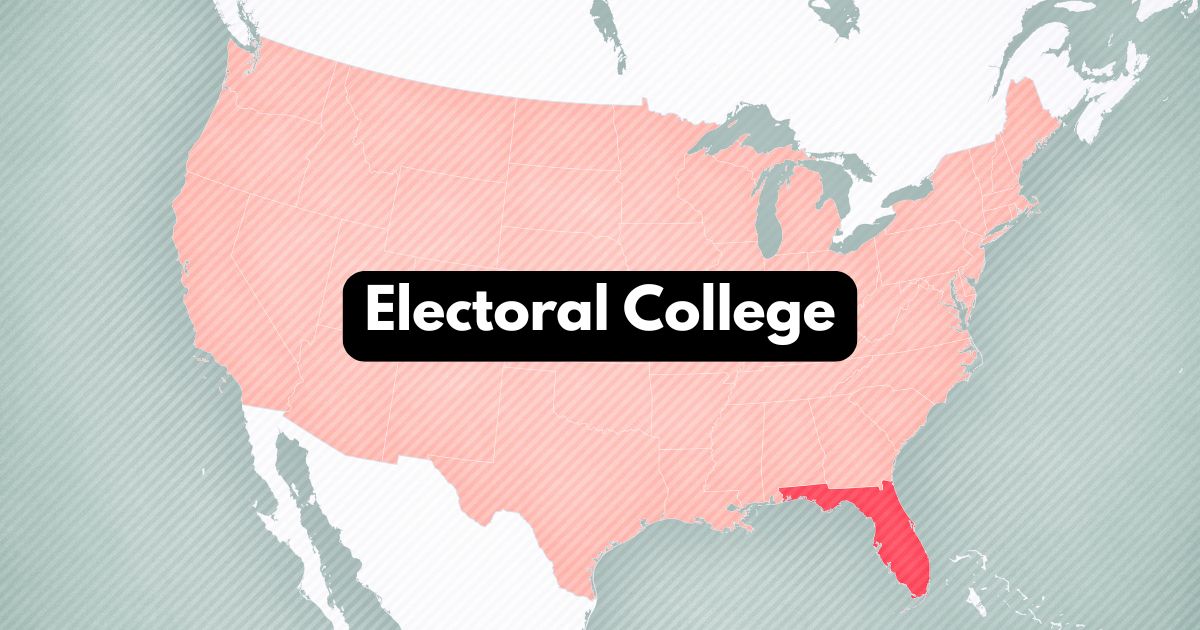
Imagine winning the national popular vote by over 500,000 ballots and still losing the presidency of the United States. This is not a dystopian political fiction; it was the exact reality of the 2000 presidential election. In most modern constitutional democracies, the mathematical formula for securing executive power is absolute: the candidate with the most individual votes wins the office. However, the American republic operates on a completely unique architectural anomaly known as the US Electoral College, a systemic blueprint where geographical boundaries matter far more than numerical majorities.
The Mechanism: Popular Vote vs. Electors
To understand why the American system functions through this fragmented framework, one must analyze the stark structural divergence between the will of the individual populace and the allocation of institutional electoral points.
| Electoral Element | National Popular Vote | US Electoral College System |
| Core Target | Total individual citizen ballots cast across the nation. | 538 total electoral points allocated to states. |
| Winner Criterion | Absolute mathematical majority of the entire population. | Securing a minimum threshold of 270 electoral points. |
| State Mandate | Treats all citizens as a single, unified electorate. | Utilizes a high-stakes “Winner-Take-All” state-level model. |
1. The Winner-Take-All Rule: Erasing Minority Ballots
The primary mechanical flaw that shocks external observers is the state-level “winner-take-all” framework utilized by 48 out of 50 states. Under this system, if a candidate wins a state by a razor-thin margin of just a single individual ballot, they are immediately awarded 100% of that state’s electoral points.
This mechanical allocation effectively erases millions of opposition ballots cast within that state. For instance, a conservative voter residing in a deeply progressive state, or a progressive voter living in a heavily conservative state, discovers that their individual ballot possesses zero structural leverage on the national stage. This concentration of power heavily mirrors the structural block voting parameters analyzed in our foundational guide on the [US Midterm Elections 2026].
2. The Swing State Monopoly: Engineering the Campaign Trail
Because the vast majority of states possess deeply entrenched, predictable partisan alignments, the entire national presidential campaign effectively contracts into a handful of highly volatile “swing states.” Factions completely ignore safe states, focusing their massive corporate funding, television advertisements, and policy promises exclusively on a tiny percentage of the national electorate.
This geographical insulation alters the legislative priorities of the federal government. Budgets, infrastructure spending, and specialized industrial subsidies are routinely directed toward these swing regions to buy political favor. As heavily detailed in our extensive investigation regarding the concentration of budgetary authority and [Rosa DeLauro Power], federal resources are continuously weaponized to secure electoral leverage ahead of critical constitutional deadlines.
[Expert Analytical Insight: The Institutional Protection of Minority Tyranny]
The traditional defense of the US Electoral College dictates that it prevents a few highly populated metropolitan cities from dominating national policy. However, the modern reality exposes a far more dangerous systemic hazard: it actively subsidizes minority tyranny. When a candidate can capture the highest office in the world while experiencing a massive deficit in the national popular vote, the foundational concept of democratic legitimacy is shattered.
This structural disconnect deepens public cynicism, convincing the citizenry that the entire voting infrastructure is an engineered illusion designed to protect establishment entities. Rather than fostering national unity, this archaic cartography locks the nation into a state of permanent polarization, where rural and urban geographies treat each other as existential threats rather than co-equal participants in a shared constitutional republic.
The Digital Vulnerability and Legislative Overhaul
The friction surrounding this complex system has intensified due to the integration of modern hyper-targeted digital media campaigns. Foreign and domestic political action committees no longer need to alter public opinion across the entire United States; they merely need to manipulate a few thousand swing-state voters using advanced algorithmic modeling.
Managing this micro-targeted digital warfare has forced state capitals to implement aggressive new safeguards, a crisis thoroughly explored in our current report on [AI Election Laws]. If the legislature fails to establish uniform transparency parameters, the stability of the entire voting system faces severe vulnerability.
Furthermore, procedural changes to electoral count rules are constantly blocked by entrenched institutional dynamics, a state of gridlock fueled by tools like the Senate supermajority rule, as outlined in our comprehensive breakdown of [What is Filibuster] . According to historical archival data hosted via the National Archives and Records Administration [Electoral College Functions], any structural reform to this constitutional process requires an amendment threshold that modern polarized majorities simply cannot achieve.
Conclusion: The Cartography of Tomorrow
Ultimately, the survival of the American electoral architecture depends heavily on whether the public continues to accept a system where a dollar or a geographic boundary holds more leverage than an individual voice. While the constitutional framework remains highly insulated from radical structural change, the growing divide between the popular vote and the electoral winner poses a continuous, lingering challenge to the stability of the republic.