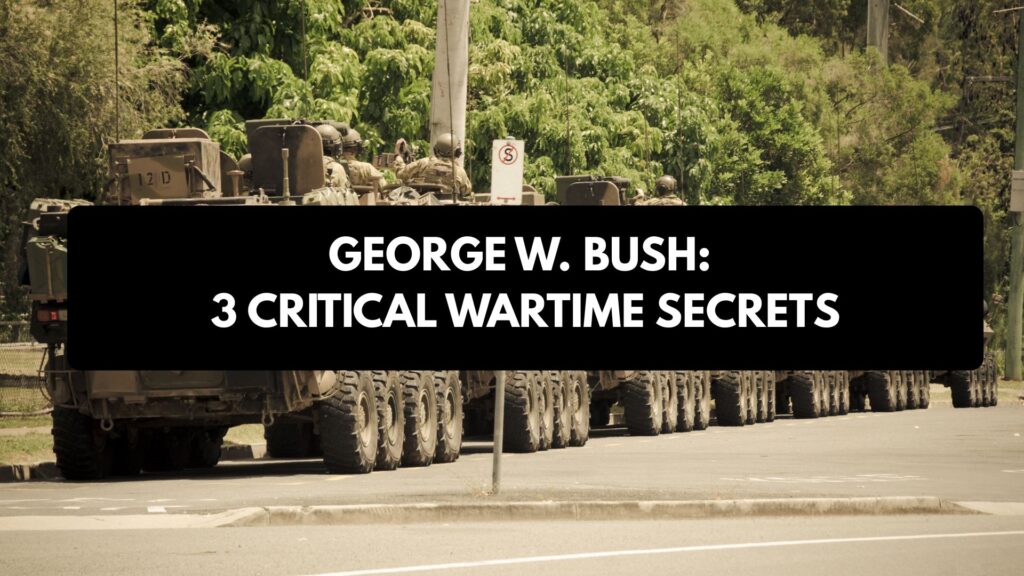
The dawn of the twenty-first century introduced an unprecedented structural rupture within the framework of global sovereignty and American domestic security. Guided by the highly polarizing, moralistic rhetoric of America’s forty-third chief executive, the historical footprint of George W. Bush is permanently defined by the sweeping, explosive parameters of the “War on Terror.” Yet, moving behind the televised executive decrees and battlefield victory declarations exposes an intensely isolated, high-leverage administrative apparatus—a regime characterized by midnight panic inside deep underground military command bunkers, systemic intelligence miscalculations regarding foreign threat matrices, and defensive domestic policies that fundamentally reshaped the legal boundaries of civil liberties.
The Underground Panic: Midnight Decisions and Texas Romances
The definitive turning point of this administration was executed far from the public view of the Oval Office, deep within the heavily fortified, subterranean chambers of the Presidential Emergency Operations Center (PEOC) on September 11, 2001. As untraceable commercial aircraft were transformed into kinetic weapons against the nation’s financial and military infrastructure, the executive branch operated in a state of absolute physiological and strategic shock.
White House inner-circle logs reveal that during those chaotic first hours, the president was forced into an insulated, airborne command posture aboard Air Force One, navigating conflicting intelligence signals that suggested an impending, multi-pronged decapitation strike against the federal government. This intense state of emotional siege permanently forged his foreign policy doctrine, transforming an executive who had campaigned on a humble foreign policy into a wartime leader driven by a unilateral, pre-emptive military mandate.
Paradoxically, the emotional baseline required to navigate this multi-generational conflict was anchored by a remarkably quiet, grounded domestic partnership alongside First Lady Laura Bush. Meeting at a local backyard barbecue in Texas and marrying after a swift, three-month courtship, Laura utilized her professional background as a librarian and school teacher to project an aura of serene, traditional domesticity. This gentle public image served as a highly efficient psychological buffer for the administration. While the president executed high-leverage, heavily criticized national security updates behind closed doors, his wife curated a protective social shield, neutralizing the aggressive rhetoric of anti-war factions on the home front.
The Mathematics of Conflict: Geopolitical Operations and Domestic Realigments
The administrative execution of this wartime regime initiated the most radical consolidation of federal surveillance and national defense infrastructure since the start of the Cold War.
-
The Department of Homeland Security: Masterminded the largest bureaucratic reorganization in modern executive history, consolidating 22 separate federal agencies into a unified administrative apparatus to manage domestic security.
-
The Patriot Act Mandate: Successfully pushed through sweeping legislative packages that drastically expanded the legal authority of federal intelligence agencies to execute warrantless digital wiretaps and monitor citizen data grids.
-
The Financial Evaporation: The multi-theater military campaigns systematically consumed federal capital, driving the national debt from approximately $5.7 trillion to over $10.6 trillion by the conclusion of the second term.
-
The Hurricane Katrina Crisis (2005): Severely damaged the administration’s domestic operational credibility due to catastrophic, bureaucratic delays in federal emergency deployment following the destruction of New Orleans.
The Cold Math of Pre-emption: The War in Numbers
The eventual domestic political collapse of the administration’s foreign policy trajectory was heavily driven by the unvarnished data emanating from the post-invasion stabilization efforts in the Middle East. According to declassified deployment registries and economic audits archived via the official federal historical collection, the systemic velocity of the military engagements created staggering long-term material obligations:
-
Active Military Personnel Peak (2007): Authorized a dramatic, highly controversial “surge” that pushed active federal troop numbers in Iraq past 170,000 personnel.
-
The Human Casualty Metric: Over 4,400 American service members permanently lost in Iraq, alongside over 2,300 casualties in Afghanistan, and hundreds of thousands of localized civilian fatalities.
-
The Intelligence Failure: The central operational justification for the 2003 invasion—the mandatory clearance of suspected stockpiles of weapons of mass destruction (WMD)—was forensically proven to be a total structural illusion, severely damaging American credibility on the global diplomatic stage.
[Expert Analytical Insight: The Messianic Delusion of Neoconservative Globalism]
The contemporary historical critique of the forty-third presidency focus almost exclusively on the intelligence failures surrounding the WMD dossiers, yet this framing misses a deeper, far more dangerous systemic pathology: the messianic delusion that democratic state-building can be successfully executed at the tip of a bayonet. He operated under a rigid, neoconservative moral framework that divided the global landscape into absolute categories of good and evil, genuinely believing that the United States possessed a divine mandate to export its institutional models via military force.
The systemic hazard for the modern electorate is that contemporary foreign policy factions continue to inherit this exact missionary prototype. They continuously mistake raw military dominance for political legitimacy, completely blind to the reality that complex, generational tribal and cultural dynamics cannot be brought into compliance by top-down administrativespending and high-tech shock-and-awe tactics. When a nation allows its executive branch to declare a permanent, global war against an abstract tactic like “terror,” it automatically commits its youth and national wealth to a state of unceasing, automated empire-building that hollows out domestic infrastructure from within.
Connecting Wartime Precedents to the 2026 Legislative Fuse
The profound expansion of executive surveillance authority and unilateral military deployment precedents initiated during the early 2000s continue to serve as the primary legal coordinates defining contemporary congressional polarization. The fundamental constitutional question of whether the executive branch can utilize administrative agencies to execute warrantless domestic intelligence collections remains a vital flashpoint.
The structural control of the upcoming legislative chambers dictates whether these historical national security oversights face severe fiscal checks or receive total legislative deference. As heavily detailed in our primary analytical index evaluating the upcoming [US Midterm Elections 2026], the contemporary congressional battles over intelligence accountability, military funding, and data privacy are a direct, uninterrupted continuation of the structural precedents established by the Bush administration.
Furthermore, the persistent gridlock surrounding federal surveillance renewals remains heavily driven by procedural tools like the Senate cloture threshold, a mechanism thoroughly analyzed in our report on [What is Filibuster].
Conclusion: The Architecture of Security
Ultimately, evaluating the legacy of this polarizing executive requires an absolute willingness to separate profound patriotic resolve from catastrophic strategic miscalculations. He was an exceptionally disciplined crisis leader who successfully insulated the domestic population from secondary catastrophic strikes following 9/11, yet his doctrines fractured international alliances and saddled the nation with multi-trillion-dollar military deficits. By exploring both the grandeur of his homeland defense infrastructure and the grim, data-driven realities of his foreign interventions, the public discards a flat caricature to discover the real, unvarnished machinery of American power.