[태그:] Erase Collections

  • 28 The Pay-for-Delete Settlement Strategy: Credit Guide

    The Pay-for-Delete Settlement Strategy
    Utilizing The Pay-for-Delete Settlement Strategy ensures that debt collection records are completely removed from your credit reports upon payment.

    The Pay-for-Delete Settlement Strategy is the single most effective yet vastly misunderstood negotiation framework available to consumers who are striving to eliminate derogatory collection accounts from their credit profiles. Few financial experiences are as deeply disheartening and infuriating as making the ultimate personal sacrifice to save money, paying off a collection agency in full, and then watching in disbelief as your credit score remains completely broken.

    Millions of hardworking Americans fall into this exact psychological trap every single year. They naturally assume that taking responsibility and paying off an old debt balance will automatically clean up their credit history and restore their financial dignity. Unfortunately, standard traditional credit scoring algorithms—such as FICO 8—treat a “Paid Collection” record almost identically to an “Unpaid Collection” record. The severe penalty remains, leaving you feeling helpless, mentally exhausted, and financially drained—having surrendered your hard-earned cash while achieving zero credit score recovery.

    “Surrendering money to a debt collection agency without securing a prior legal deletion contract does not repair your credit standing. True financial recovery requires negotiating the absolute removal of the credit entry in exchange for your payment.”

    Understanding the Pitfall: Option A vs. Option B

    When confronting debt collectors, the long-term impact on your financial trajectory depends entirely on your negotiation strategy prior to transferring any funds:

    • Option A: Unconditional Payment (The Fatal Pitfall): You call the collection agency, negotiate a payment over the phone, and send the money without a written deletion guarantee. The collector updates the tradeline balance to zero dollars and marks the status as “Paid Collection.” However, the underlying negative mark remains embedded in your credit history for up to seven years, severely suppressing your FICO score and blocking you from securing home mortgages, auto loans, or favorable credit cards.

    • Option B: The Pay-for-Delete Settlement Strategy (The Solution): You leverage your monetary payment as maximum bargaining power. You strictly refuse to release a single dollar until the collection agency signs a formal, written agreement pledging to submit an immediate, complete deletion request to Experian, Equifax, and TransUnion upon receipt of the agreed funds.

    The 4-Step Sequential Solution to Erase Collections

    To successfully execute The Pay-for-Delete Settlement Strategy without falling victim to unfulfilled verbal collection promises, follow this strict, four-step chronological protocol:

    Step 1: Establish Absolute Legal Verification

    Before offering any monetary settlement, you must verify that the collection agency possesses legal title to the debt and that the obligation is valid. Always initiate The Debt Validation Demand to ensure the debt is completely accurate and has not exceeded the expiration limits outlined under The Statute of Limitations Shield.

    Step 2: Conduct Written-Only Negotiations

    Never negotiate settlement agreements over the phone, as oral promises made by collection representatives are legally unenforceable and impossible to verify. Send a written settlement proposal via certified mail offering a realistic lump-sum payment—typically between 30% and 50% of the reported total—strictly contingent upon their binding promise to completely purge the tradeline from all credit bureaus.

    Step 3: Secure an Executed Written Contract

    Do not transfer any funds under any circumstances until you receive a physical letter printed on official company letterhead, signed by an authorized collection manager, explicitly stating: “In consideration of the agreed payment of $X, our agency agrees to request the permanent deletion and removal of this entire account entry from Experian, Equifax, and TransUnion within 30 days.” For additional guidance on consumer rights during debt settlement, consult official regulatory frameworks provided by the Consumer Financial Protection Bureau (CFPB).

    Step 4: Execute Payment via Secure Cashier’s Check

    Submit the agreed funds using a secure cashier’s check or certified money order. Never provide personal check details, direct debit information, or credit card numbers, as collectors can misuse this access. Retain copy receipts of the payment and audit your credit reports 30 to 45 days later to confirm total deletion.
  • 26 The Debt Validation Demand: FDCPA Legal Guide

    The Debt Validation Demand
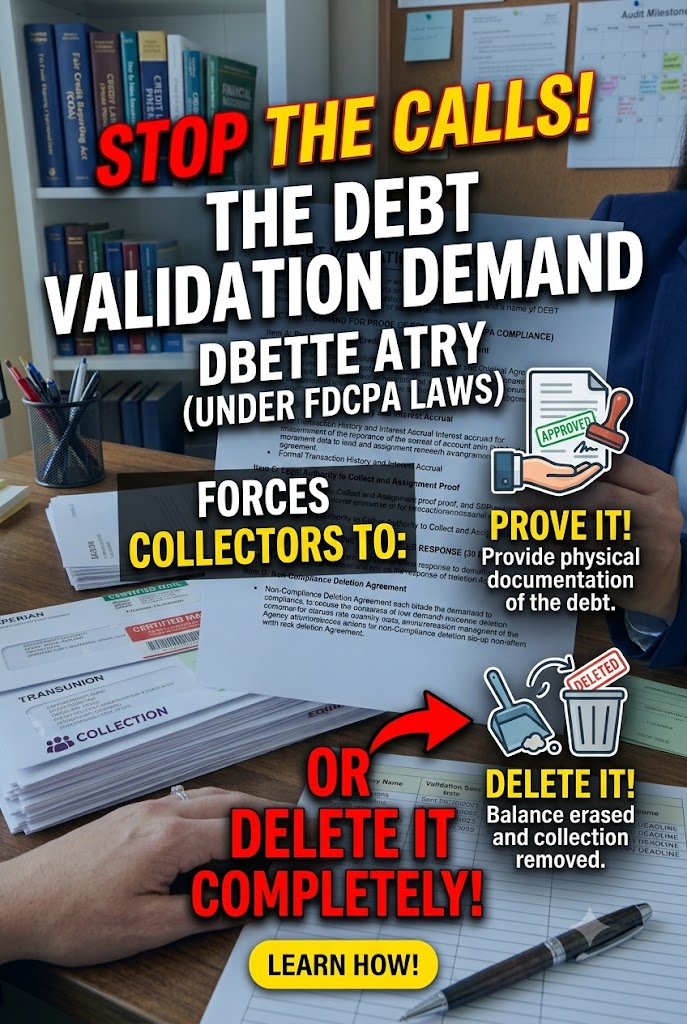
    Issuing a formal Debt Validation Demand forces third-party collection agencies to physically prove account accuracy or delete the balance entirely.

    WASHINGTON, D.C.The Debt Validation Demand remains the primary legal weapon guaranteed to American consumers under the Fair Debt Collection Practices Act (FDCPA) to force third-party debt collectors to halt collection activities or physically prove the legitimacy of an alleged debt. According to legal experts and federal financial regulatory frameworks, an estimated 40% of collections purchased by debt buyers contain inaccurate balances, expired statutes of limitations, or incorrect consumer identity details. Understanding how to exercise this statutory right under federal law determines whether a consumer pays an unverified debt or successfully forces a complete account deletion.

    “Under federal law, third-party debt collectors carry the strict burden of proof. A consumer is never legally obligated to pay a collection agency until the collector provides original, itemized physical verification.”

    5W1H Analysis: The Mechanics of The Debt Validation Demand

    • WHO (Target & Beneficiary): Third-party debt collection agencies acting as buyers of charged-off consumer debt are the targets. Individual consumers facing collection calls, demand letters, or collection entries on their credit reports are the primary beneficiaries.

    • WHAT (The Legal Remedy): The Debt Validation Demand is a formal, written notice invoking Section 809(b) of the FDCPA. It legally compels a collection agency to cease all contact and provide physical documentation verifying the original debt balance, the original creditor’s identity, and proof of legal authority to collect.

    • WHEN (The Statutory Window): Consumers must dispatch this formal demand within exactly thirty (30) days of receiving the initial written notice from a collection agency. Invoking this right within the 30-day window triggers an absolute legal freeze on collection attempts.

    • WHERE (Jurisdiction & Enforcement): Enforced across all fifty U.S. states under federal jurisdiction monitored by the Consumer Financial Protection Bureau (CFPB).

    • WHY (The Financial Protection): Collection agencies purchase portfolios of delinquent debt for pennies on the dollar, often receiving incomplete digital spreadsheets lacking original signed contracts or complete accounting ledgers. Demanding physical validation exposes these evidentiary gaps.

    • HOW (Execution Strategy): Sent via U.S. Postal Service Certified Mail with Return Receipt Requested to establish verifiable proof of delivery and start the statutory compliance timeline.

    Option A vs. Option B: Oral Disputes vs. Written Statutory Demands

    When confronted by debt collectors, consumer outcomes are dictated entirely by whether they rely on informal verbal communications (Option A) or formal statutory demands (Option B).

    Option A: Informal Phone Disputes

    • Legal Standing: Phone calls do not preserve legal rights under FDCPA Section 809(b).

    • Collector Response: Collection representatives routinely use aggressive tactics to secure partial payment promises, which can legally restart expired statutes of limitations.

    • Outcome: Collection calls continue, and negative credit marks remain intact on consumer credit profiles.

    Option B: Written Debt Validation Demands

    • Legal Standing: Triggers a mandatory freeze on all collection efforts under federal law until full written validation is provided.

    • Collector Response: Collectors must either locate original documentation from the primary creditor or permanently close the file and delete credit bureau reporting.

    • Outcome: Unverified debts are permanently removed, and consumer rights remain fully protected under federal statutes.

    Strategic Implementation and Escalation

    To maximize effectiveness, consumers must combine The Debt Validation Demand with established administrative protocols like The Bureau Audit Protocol. If a debt collection firm fails to provide itemized verification yet continues to report the debt to Experian, Equifax, or TransUnion, they commit a direct violation of federal law.

    In such instances, submitting certified copies of the delivery receipt and non-compliance notice to federal regulators forces immediate administrative remedies and potential monetary statutory damages for the consumer.