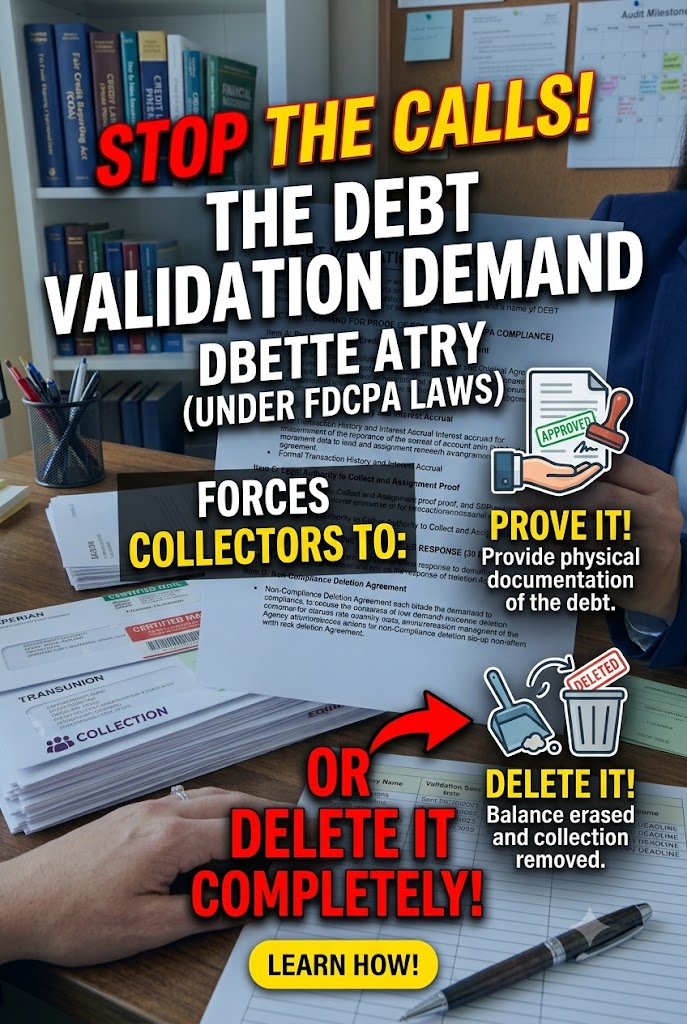
WASHINGTON, D.C. — The Debt Validation Demand remains the primary legal weapon guaranteed to American consumers under the Fair Debt Collection Practices Act (FDCPA) to force third-party debt collectors to halt collection activities or physically prove the legitimacy of an alleged debt. According to legal experts and federal financial regulatory frameworks, an estimated 40% of collections purchased by debt buyers contain inaccurate balances, expired statutes of limitations, or incorrect consumer identity details. Understanding how to exercise this statutory right under federal law determines whether a consumer pays an unverified debt or successfully forces a complete account deletion.
“Under federal law, third-party debt collectors carry the strict burden of proof. A consumer is never legally obligated to pay a collection agency until the collector provides original, itemized physical verification.”
5W1H Analysis: The Mechanics of The Debt Validation Demand
-
WHO (Target & Beneficiary): Third-party debt collection agencies acting as buyers of charged-off consumer debt are the targets. Individual consumers facing collection calls, demand letters, or collection entries on their credit reports are the primary beneficiaries.
-
WHAT (The Legal Remedy): The Debt Validation Demand is a formal, written notice invoking Section 809(b) of the FDCPA. It legally compels a collection agency to cease all contact and provide physical documentation verifying the original debt balance, the original creditor’s identity, and proof of legal authority to collect.
-
WHEN (The Statutory Window): Consumers must dispatch this formal demand within exactly thirty (30) days of receiving the initial written notice from a collection agency. Invoking this right within the 30-day window triggers an absolute legal freeze on collection attempts.
-
WHERE (Jurisdiction & Enforcement): Enforced across all fifty U.S. states under federal jurisdiction monitored by the Consumer Financial Protection Bureau (CFPB).
-
WHY (The Financial Protection): Collection agencies purchase portfolios of delinquent debt for pennies on the dollar, often receiving incomplete digital spreadsheets lacking original signed contracts or complete accounting ledgers. Demanding physical validation exposes these evidentiary gaps.
-
HOW (Execution Strategy): Sent via U.S. Postal Service Certified Mail with Return Receipt Requested to establish verifiable proof of delivery and start the statutory compliance timeline.
Option A vs. Option B: Oral Disputes vs. Written Statutory Demands
When confronted by debt collectors, consumer outcomes are dictated entirely by whether they rely on informal verbal communications (Option A) or formal statutory demands (Option B).
Option A: Informal Phone Disputes
-
Legal Standing: Phone calls do not preserve legal rights under FDCPA Section 809(b).
-
Collector Response: Collection representatives routinely use aggressive tactics to secure partial payment promises, which can legally restart expired statutes of limitations.
-
Outcome: Collection calls continue, and negative credit marks remain intact on consumer credit profiles.
Option B: Written Debt Validation Demands
-
Legal Standing: Triggers a mandatory freeze on all collection efforts under federal law until full written validation is provided.
-
Collector Response: Collectors must either locate original documentation from the primary creditor or permanently close the file and delete credit bureau reporting.
-
Outcome: Unverified debts are permanently removed, and consumer rights remain fully protected under federal statutes.
Strategic Implementation and Escalation
To maximize effectiveness, consumers must combine The Debt Validation Demand with established administrative protocols like The Bureau Audit Protocol. If a debt collection firm fails to provide itemized verification yet continues to report the debt to Experian, Equifax, or TransUnion, they commit a direct violation of federal law.
In such instances, submitting certified copies of the delivery receipt and non-compliance notice to federal regulators forces immediate administrative remedies and potential monetary statutory damages for the consumer.